
Why kettles die, and the ten-minute job that prevents it

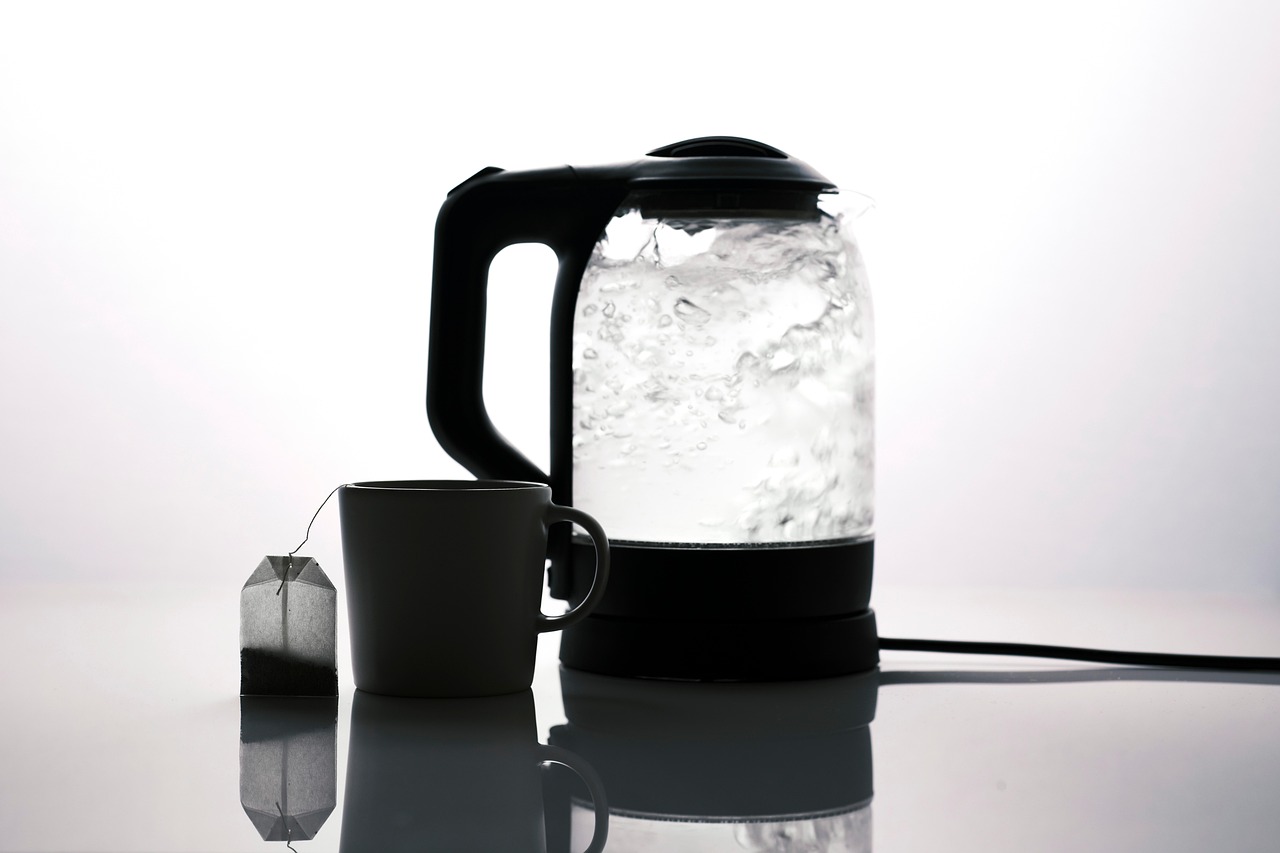
The most common repair enquiry we get about kettles is not a repair at all. It is a kettle that has become slow, noisy, and prone to switching off before it boils — and in the great majority of those cases the fault is a layer of calcium carbonate on the heating element.
Scale is not a fault with the kettle. It is dissolved mineral coming out of the water when it is heated, and in a hard-water area it accumulates fast.
What scale does
Three things, in order of appearance.
It insulates. Scale conducts heat poorly. The element has to reach a higher temperature to deliver the same heat to the water, so the kettle takes longer and uses more electricity.
It makes noise. The rumbling of an old kettle is water flashing to steam in pockets underneath the scale layer. That is not a cosmetic problem — it is localised overheating.
It confuses the thermostat. Many kettles cut out on a bi-metallic strip that responds to steam. Scale on the element and around the sensor changes when and how steam reaches it, which is why a scaled kettle clicks off early or refuses to click off at all.
Left long enough, the element runs hot enough to fail. At that point the kettle is genuinely finished, and it was preventable.
How often
It depends entirely on your water. A useful test: look at the inside of the kettle after two weeks of normal use. If you can see a chalky bloom on the element or the base, descale monthly. If it takes three months to appear, descale quarterly.
Do not wait until you can feel the scale as a crust. By then it takes several cycles to remove.
The routine
- Fill the kettle to about half with a solution of white vinegar and water in equal parts, or with a citric acid solution — roughly a tablespoon of citric acid powder to a litre of water.
- Bring it to the boil and switch it off.
- Leave it to stand for twenty minutes to an hour. The acid does the work; time matters more than strength.
- Pour it out. Any softened residue should wipe away with a soft cloth — do not scrape the element.
- Rinse thoroughly, then fill with fresh water, boil, and discard. Do this twice. Nobody wants a vinegar tea.
If a manufacturer supplies a descaler for the model, use that instead — some kettles have plastic components that dislike acetic acid.
What not to do
- Do not scrape. A scratched element scales faster, because the scratch gives crystals something to grip.
- Do not use a wire pad or an abrasive cream. Same reason.
- Do not use bleach. It does nothing to scale and it damages the seals.
- Do not leave water standing. Empty the kettle after use if you can. Standing hot water scales faster than fresh cold water.
Filters, and what they do and do not do
The mesh filter in the spout catches loose flakes of scale so they do not end up in the cup. It does not prevent scale forming, and a blocked one slows the pour and can cause the kettle to spit. Take it out and rinse it whenever you descale.
Water filter jugs reduce the mineral load before it reaches the kettle and genuinely do slow scaling. They also have a stated capacity — once past it, the cartridge is doing very little, and cartridges get left in far longer than they should be.
The same job on other appliances
Anything that heats water is on the same schedule.
- Coffee makers. Scale in the boiler and the tubing reduces brew temperature, which makes coffee taste weak and sour. Most have a descale cycle; run it when the light asks rather than when you get round to it.
- Steam mops and steam cleaners. The jet blocks before the boiler does. Many manufacturers require distilled water, and it is worth following.
- Irons. Scale comes out of the soleplate as white flecks onto whatever you are pressing.
When it really is the kettle
A kettle that trips a breaker, shows any sign of leaking from the base, or has a damaged cord is out of service immediately — those are not descaling problems. A kettle whose element has visibly burned or discoloured beyond the scale layer has usually run dry at some point and is at the end of its life.
Everything short of that is usually recoverable with an hour of vinegar and no tools at all.
Why a shop that sells kettles writes this
Because a kettle that fails in eighteen months is a bad experience with something we recommended, and we would rather sell you one in six years than two in six years. Where a product we list has a specified descaling routine or requires distilled water, that appears on the listing.
Common questions
How often should I descale my kettle?
Look inside after two weeks. Visible chalky deposit means monthly; if it takes three months to appear, quarterly is enough. Do not wait until you can feel a crust.
Does a water filter jug stop limescale?
It reduces hardness, which slows scaling meaningfully — but it does not eliminate it. Think of it as lengthening the interval between descalings rather than replacing them.
My kettle clicks off before boiling. Is it broken?
Usually scale on the element confusing the steam-sensing thermostat. Descale it thoroughly before concluding anything. If it still cuts out early afterwards, the thermostat has genuinely failed.
Browse the range: all products · about Goldsmith Appliance · ask us a question.